

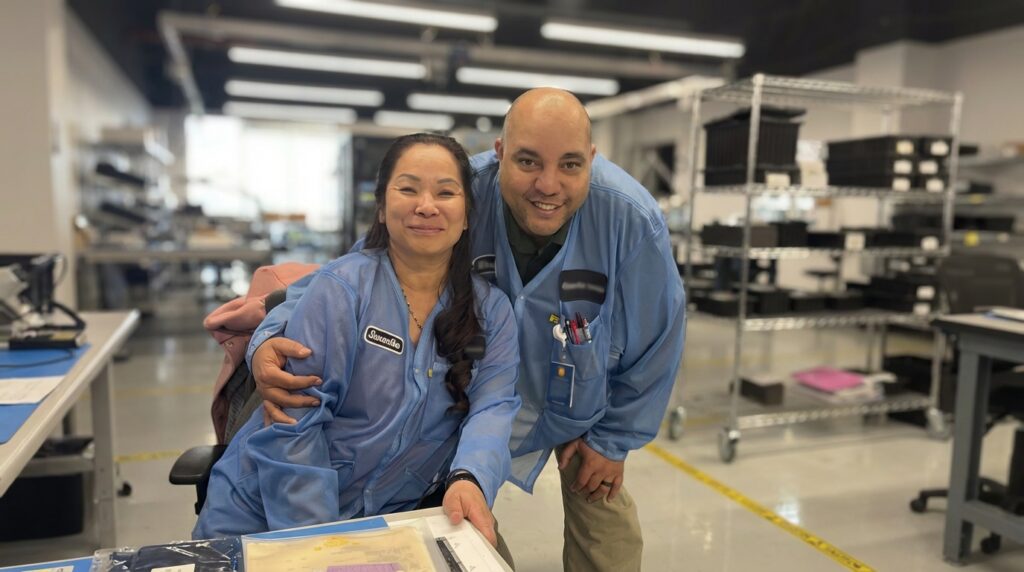
Good morning everyone, and thank you for letting us share our experience today about job loss and opportunities.
Ikeda Sensei writes:
Mr. Makiguchi taught that there are three kinds of value: beauty, benefit and good. In the working world the value of beauty means to find a job you like; the value of benefit is to get a job that earns you a salary that can support your daily life; the value of good means to find a job that helps others and contributes to society.
— Daisaku Ikeda, Faith into Action, pg. 45
The Three Kinds of Value
This guidance has shaped the way my husband, Dimitri, and I view every workplace we’ve been in.
Over the years, we’ve had our share of job losses and opportunities. But each company became a place where we transformed ourselves and our environment into beauty, benefit and good. We believe we created positive change wherever we went — building trust, supporting others, and improving processes. And every time we left a job, people were genuinely sad to see us go. We brought sunshine, our Buddha nature, to each place.
Choosing Integrity Over a High-Paying Job
In June 2023, I faced a difficult decision: stay in a place where I wasn’t treated well, or move on and begin a new mission. I knew this was a moment for my human revolution. I won’t share every detail (it would take the whole meeting) but I knew one thing: I treat my life with the utmost care. I don’t stay in environments where I’m not valued, especially when I’ve given my all. And I would never compromise my integrity just to keep a high-paying job.
Dimitri and I talked it through. He said, “No matter what you decide, I will support you 100 percent. Don’t worry. Enjoy yourself. Take your time to find something better.”
After many hours of chanting Nam-myoho-renge-kyo to the Gohonzon, I made my decision — with no regrets. I left the high-paying job I had been at for almost four years.
A Daily Rhythm of Faith and Action
Since Dimitri would be the only one working, I didn’t want to burden him with all the expenses. So I strengthened my determination. I increased my morning chanting to two hours. And every morning I asked myself, What does it look like for Dimitri and I to work in a company where we can create beauty, benefit and good?
After chanting, I read the World Tribune, Living Buddhism, and Sensei’s guidance aloud so I could hear the power of the words. Then I would take our dogs to the park, update our resumes, search job listings, and send applications. I followed this rhythm every day for a month. Also, we continued to attend our discussion meeting and shared Nam-myoho-renge-kyo with others.
And I didn’t just look for a job for myself. I looked for Dimitri too. By applying the strategy of the Lotus Sutra before anything else, I didn’t have time to worry or doubt. I focused on taking the right actions.
At the end of the month, one employer contacted me for a phone interview, which went well. They scheduled an in-person interview the following week. Around that same time, a recruiter from Indeed reached out about a job I never even applied for. I asked if he could also help my husband. He said yes and told me to send his resume. I ended up with three interviews scheduled in one day: two for me, one for Dimitri.
Before the interviews, I continued my two hours of chanting and reading Sensei’s guidance aloud. I also chanted to have my Buddha nature shake hands with their Buddha nature — something I learned from a WD member — and for the truth to be revealed in my environment.
Over the years I’ve learned how to interview by becoming the interviewer myself. I ask questions to understand exactly what environment I’m walking into. My favorite questions are: “What makes you happy when you come to work?” And “What kind of manager style do you have?”
Fast-forward to the opportunities: I received two job offers, and Dimitri received his offer as well. I chose the second company because of the location and the genuine answers I received from the hiring managers. I felt deeply that this was where I wanted to create value. And amazingly, Dimitri was hired at the very same company.
Dimitri’s Experience
The company I was leaving had old or barely working equipment and a pattern of personnel abuse. Let me explain.
Our job is to build state of the art technology, or every day computers. The problem is that they didn’t give their employees the proper equipment but still expected us to build things that were going into space.
The personnel abuse issue is easier to explain: when a company hires people who don’t have many options, or when the job market is slow, they take advantage of employees because they know replacing them is easy. But they had a different issue when it came to dealing with me. Just as Sensei teaches,
It’s important to have the courage to clearly say what needs to be said when it matters most.
— Daisaku Ikeda, The New Human Revolution, Vol. 20, Bridge Building Chapter
I have never had a problem with courageous communication or standing up to abusers. And I’m fortunate to have a wife who cooperates with me, because as Sensei says:
Partners in a relationship bring forth various qualities. There are times when the intensity and power of the sun are called for, and times when the soothing luminescence and serene wisdom of the moon is what’s needed. A complementary relationship in which the partners cooperate and work together is a beautiful thing.
— Daisaku Ikeda, The Complete Works of Daisaku Ikeda, Vol. 61
Now, the company we were interviewing for was not new to me. I knew them from the previous job I had. I was the guy picking up and returning their equipment that needed calibration, on a weekly basis. So when the recruiter mentioned the job opportunity to Sunantha before her interview, I told her, “I think I know that company.” And I remembered thinking I wouldn’t mind working for them because people looked happy working there.
So, on the day of the interview Sunantha arranged for me, I arrived a few minutes early, as one should. The interview was in a conference room right near the front entrance. I had just come from work and had changed into business-casual clothes in the car.
When I walked through the entrance, I saw Sunantha laughing and having fun with the hiring team, as they were leaving the conference room. She introduced me casually when she saw me, and honestly, it felt like I was hired right then and there — before the interview even started.
After that day, we both got hired and today, the value we bring is appreciated, largely because we have the courage to speak up, when others stay silent. Our suggestions and pointers have improved the working conditions, documentation, equipment, benefits employees receive and the company in overall.
Conclusion: Transforming Reality Through Daimoku (Nam-myoho-renge-kyo)
In closing, Ikeda Sensei writes:
We must continue chanting daimoku during times of both suffering and joy. The emphasis here is ‘continue’, and it is key that we do so throughout ‘both suffering and joy’. When confronted with suffering, we must not retreat. We should suffer what there is to suffer. This is neither resignation or escapism. We need to fix our gaze unflinchingly on reality and bravely challenge it based on daimoku. The Daishonin is explaining that this is the correct attitude for practitioners of the Mystic Law. Faith in the Daishonin’s Buddhism is constantly directed toward transforming reality.
— Daisaku Ikeda, Lectures on Attaining Buddhahood in this Lifetime, pg. 57-58